 Size chart






Body Types in Plus Size: Proportions as Silhouette Composition
Reading time 5 min24.12.2025
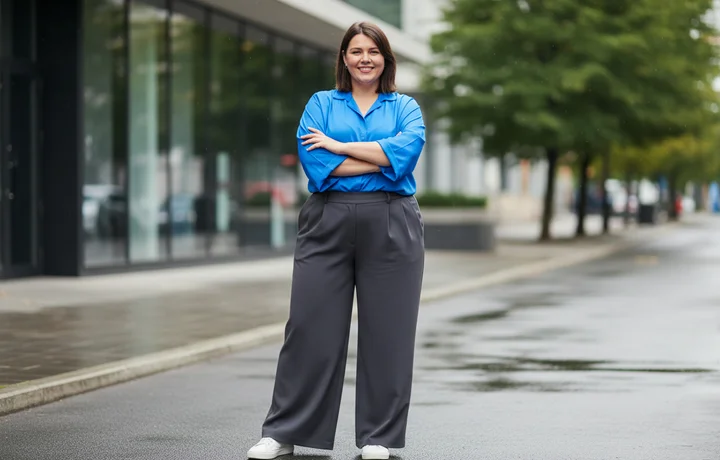
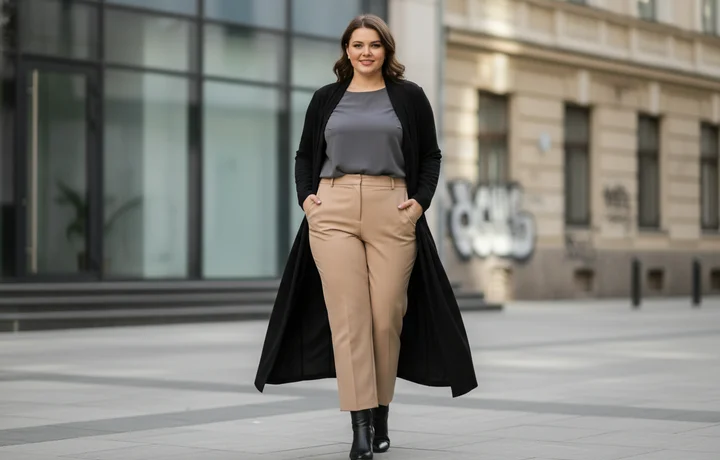
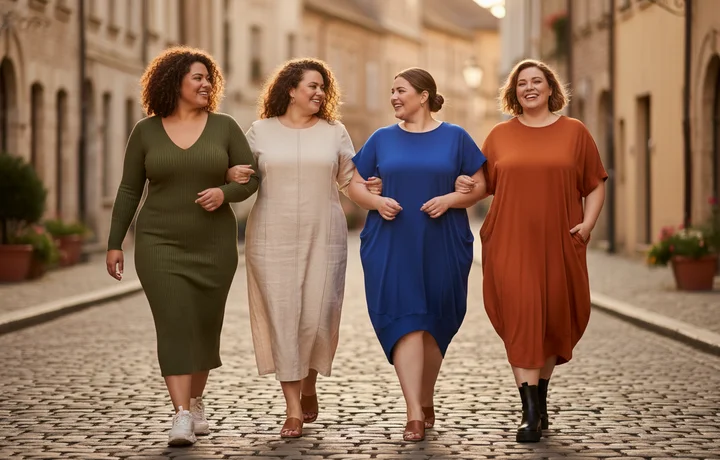
Every woman is beautiful in her own body — not “in spite of it,” but exactly as she is. Art history remembers this beautifully: in the Renaissance, the ideal was living, soft, real forms — ones with warmth, strength, and femininity. Not “one standard,” but the beauty of diversity.
Examples of how a cut works with silhouette composition can be seen in the catalog: the MAYA skirt or the ZOE blazer.
In art, the body was never a “problem to solve.” It was the subject: the line of a shoulder, the roundness of a hip, the softness of a belly, the play of the back. The masters didn’t hide volume — they worked with light and fabric so the form would resonate even more beautifully. That’s exactly why these images still look so convincing today: there’s life in them, not a striving to “fit” someone else’s expectations.
Clothing in this story is neither a judge nor a corrector. It’s a frame for the painting: it can enhance what you already like about yourself and add confidence to your everyday movements.

A frame for the painting — everyone has their own
If clothing is a frame for the painting, then logically, there’s no “universal” frame. What looks calm and elegant on one woman can read completely differently on another — not because one “painting” is better or worse, but because its composition is different.
In painting, this is felt instantly: a different shoulder line, a different waist softness, different hip weight — and the fabric falls differently. It’s the same with clothing. It doesn’t change the body — it emphasizes the proportions you already came with.
Proportions are the language of silhouette
What matters here isn’t the numbers themselves, but the ratios: shoulders, bust, waist, hips. Even as weight changes, the “logic” of the silhouette usually stays recognizable — volume may just be added in different places.
Once you see this logic, choosing becomes calmer: you’re no longer searching for “the perfect item in general.” You’re choosing a frame that supports your particular composition.
What these compositions are called
In everyday language there's a simple and handy way to describe this — the “geometric/fruit” classification. It helps briefly describe the silhouette's balance: where it's more active and where it's more restrained.
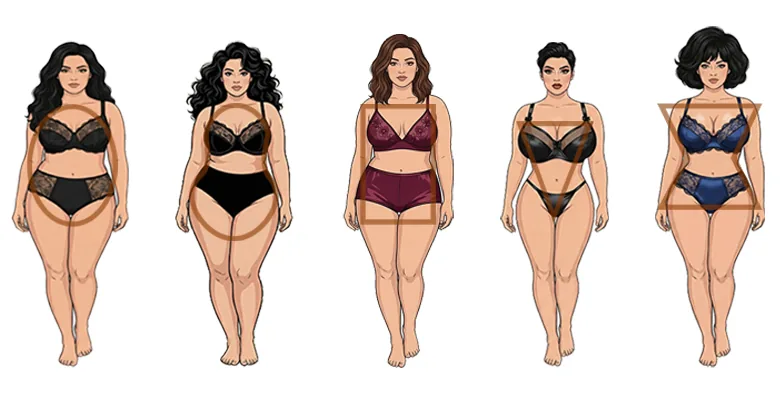
5 basic types you'll encounter most often
- Pear — the top is more delicate, the waist is more defined, and the silhouette's main volume is at the hips.
- Apple — the center of the silhouette is more active: more volume at the waist/belly and bust, while the hips can look more restrained.
- Hourglass — top and bottom are visually balanced, and the waist clearly "draws" the shape.
- Rectangle — shoulders, waist, and hips are closer in width to each other; the silhouette is straighter, without a sharp waist contrast.
- Inverted triangle — the top is more active: shoulders and/or bust are wider than the hips, with the shoulder line "leading" the composition.
How to look at yourself the way you'd look at a painting
The simplest way is to assess the balance in a mirror or in a full-length photo. Not "what's wrong with what," but what speaks first in the composition: the top (shoulders/bust line), the waist, or the bottom (hips).
- The top leads the composition — shoulders/bust are visually wider than the hips (this is usually the inverted triangle logic).
- The bottom leads the composition — hips are wider than the shoulders (this is usually the pear logic).
- Top and bottom are balanced — shoulders and hips are close in width; then look at the waist: does it "draw" the shape, or stay softer.
- The center of the composition — the middle of the silhouette "speaks" the loudest: the roundness of the waist/belly and bust forms the main focal point (this is usually the apple logic).
Mixes are about depth, just like in painting
In a strong painting, a single rule rarely works alone — interest is born from combinations: line, light, rhythm, volume. It's the same with body proportions: sometimes the top "leads" the composition while the waist is also very defined; or the hips are active, but the shoulders have character too.
It's exactly this layering that gives the most styling options: clothing can emphasize different "strengths" of your composition — depending on the mood and the goal.
When you want precision: proportions by measurements
Sometimes a glance in the mirror is enough. And sometimes you want it like in a workshop: take measurements and get a clear hint of which logic your silhouette is closest to. For that, you need a few simple measurements.
What you'll need
- a soft tape measure;
- a mirror or phone, to see that the tape lies flat;
- underwear (measure bust circumference while wearing a bra).
Two rules that really help with accuracy
- Hold the value with your finger: press down on the right mark on the tape before pulling it away from your body.
- Stand up straight: don't lean or "strike a pose" while measuring — that immediately introduces error.
Take 4 measurements + 1 visual marker
- Shoulder width — from one shoulder joint to the other (the width, not a circumference).
- Bust circumference — wearing a bra, over the most prominent points. Tape parallel to the floor.
- Waist circumference — at the narrowest point of the torso (or along your natural waistline).
- Hip circumference — over the widest part of the hips and seat.
- Tape check — check in the mirror that it's not "tilted."
How to determine your type from the numbers
Write down your bust, waist, and hip measurements (and use shoulder width as a hint for top-bottom balance), then see which logic is closest:
- Hourglass — hips are roughly equal to bust (difference up to 10% either way), and the waist is noticeably smaller than the hips (more than 25%).
- Rectangle — hips are roughly equal to bust (difference up to 10%), and the waist isn't dramatically smaller (up to 25%).
- Pear — hips are larger than bust (difference over 10%): the silhouette's main volume is concentrated below.
- Apple — the waist is close to the hips (waist is almost equal to hips), and the roundness gathers more strongly in the center of the silhouette.
- Inverted triangle — the top is visually wider: shoulders are noticeably wider than the hips; as a guideline, you can calculate it this way: shoulder width is more than half the hip circumference, by more than 10%.
These ratios aren't an exam. They're guidelines that help you grasp the logic of your proportions — and from there, you can choose styles, lengths, and lines that beautifully highlight your particular composition.
Does identifying your body type mean something needs to be "fixed"?
No. Clothing here isn’t a judge or a body corrector — it’s "a frame for a painting": it highlights the proportions you already have rather than changing your body. Body types are just a reference point that helps you choose cuts and lengths, not a reason to "hide" anything.
How do you tell "Hourglass" from "Pear" using the numbers?
"Hourglass" — hip circumference is roughly equal to bust circumference (within 10%), and the waist is smaller than the hips by more than 25%. "Pear" — hip circumference is noticeably larger than bust circumference (a difference over 10%): most of the volume sits in the lower body.
What measurements do you need to determine your body type precisely?
You’ll need four measurements: shoulder width, bust circumference (wearing a bra), waist circumference (at the narrowest point), and hip circumference (at the widest part). Use a soft measuring tape and a mirror to check it sits level.
How can you tell your body type without measurements?
Look at yourself in a mirror or in a full-length photo and see which part "leads" the composition: the top (shoulders/bust line wider than the hips), the bottom (hips wider than the shoulders), or a balance of top and bottom with a defined or softer waist.
What are the main body types?
Five basic types: "Pear" (volume in the hips, a more delicate top), "Apple" (volume around the waist/stomach and bust), "Hourglass" (balanced top and bottom, a defined waist), "Rectangle" (shoulders, waist and hips close in width), and "Inverted Triangle" (shoulders and/or bust wider than the hips).