 Size chart






“Pear” Body Type (A) in Plus Size: Proportions, Fit, and Lines in Clothing
Reading time 19 min22.01.2026
"Pear" body type (A): what it looks like and what matters most
The "pear" (A) shape is a proportion type where the main volume is concentrated in the lower body: hips, seat, sometimes the upper legs. The top looks calmer by comparison: shoulders can be narrower, the bust area less "dominant," the waist more defined or simply visually lighter.
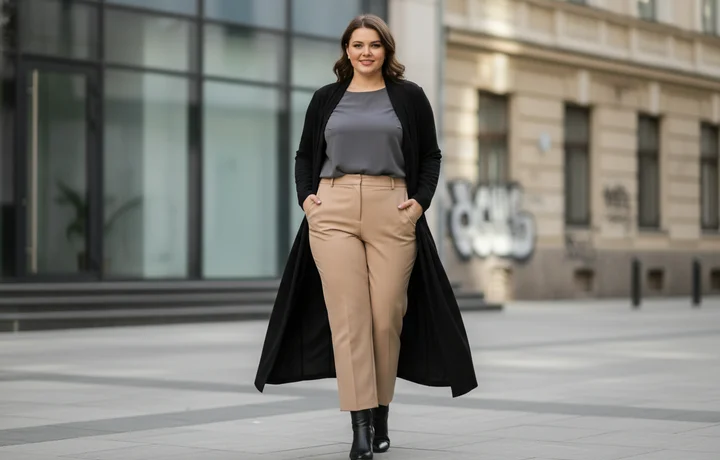
Examples of models that follow exactly this logic: the structured ZOE blazer on top and the RUMI skirt with a back slit, which doesn't end right at the widest point of the hips.
An important point: this isn't about "wide hips" as a fact. It's about where the main emphasis falls in the silhouette's composition. For a pear, it naturally goes downward — and that's exactly why clothing needs to work so the bottom is comfortable and cleanly fitted, while the top is put-together and structured.
The easiest way to recognize a "pear" (no formulas or tape measure)
Look at yourself from the front in a photo (not a low-angle selfie), in neutral clothing:
- Hips are wider than the shoulders or look heavier in the silhouette.
- If there's a waist, it usually reads clearly, but even without a defined waist, the bottom still dominates.
- When something "doesn't sit right" in stores, it's usually the bottom: pants pull at the hips, skirts ride up, fabric gathers into folds.
- Tops more often "pass" more easily: the size by shoulders/bust can be smaller than what's needed at the hips in matching sets.
Common "pear" variations in plus size
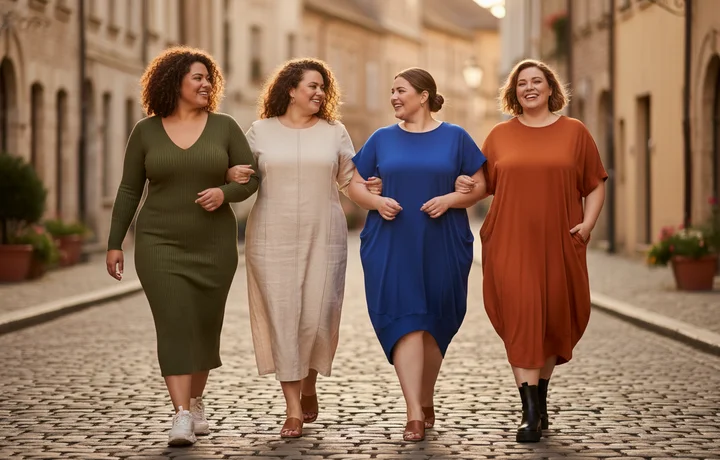
In plus size, the "pear" doesn't always look "classic" — and that's normal. Two real versions show up most often:
A1 — contrasting "pear."The top is more compact, the waist reads clearly, the hips and seat are pronounced. The "A" silhouette is visible right away.
A2 — soft "pear."The top can also be voluminous (bust, arms, back), but the lower body still sets the proportion: the bottom is noticeably more active and "heavier" in the composition.
And here's TinDay's key rule: you don't "adjust" yourself to fit the clothing — you choose clothing that supports your natural proportions.For a pear, this means: not "hiding the hips," but building balance — so the silhouette looks put-together, modern, and easy in movement.
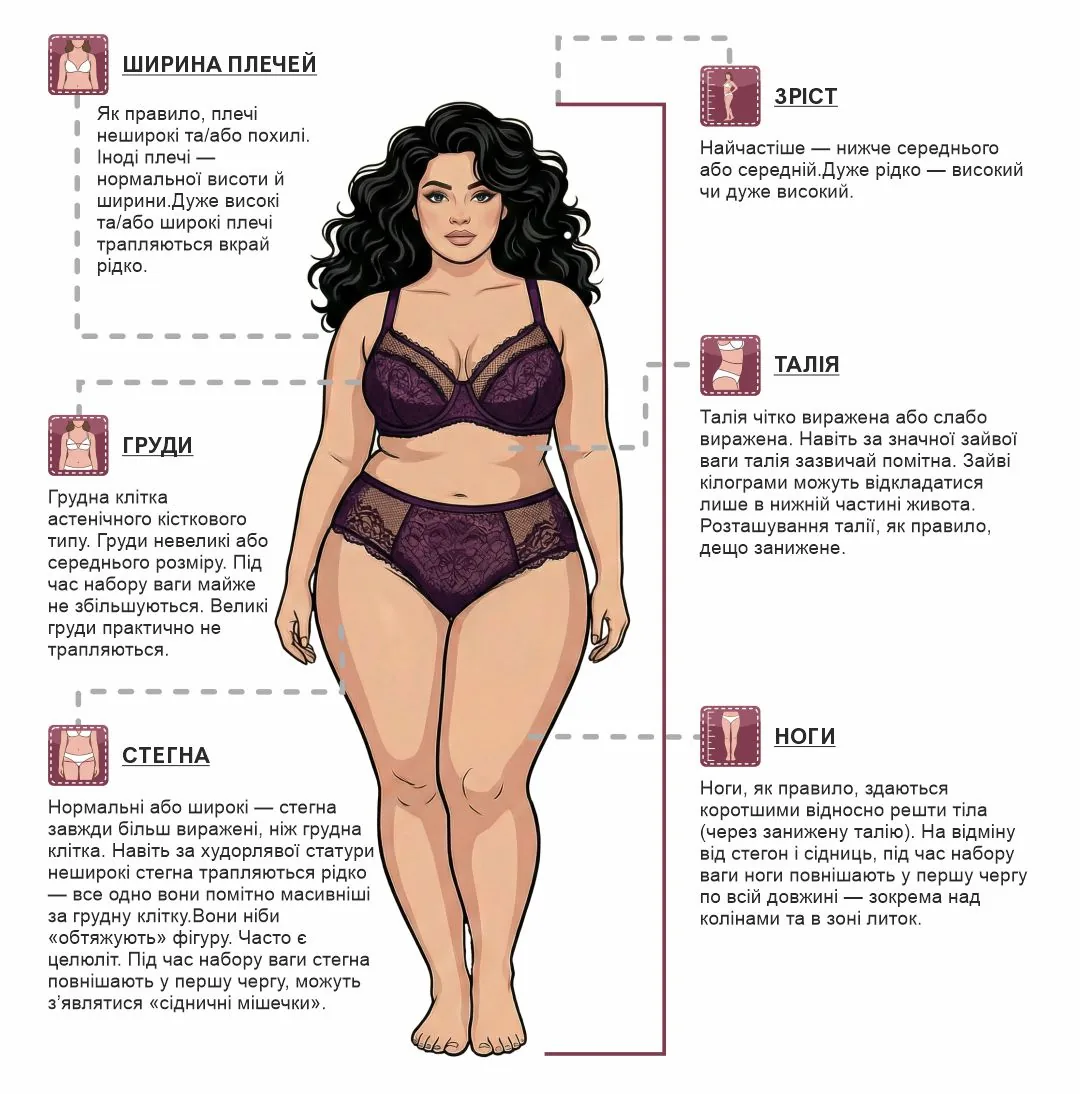
The diagram above shows the key zones to look at first: shoulders, bust, waist/belly, hips, legs, and height. For the pear body type, the point isn't to "look for a perfect waist" or try to "hide the hips," but to understand that the bottom sets the proportion: the hips are noticeably more active than the top, and the shoulders and bust area look calmer. The following sections build on exactly this — how to add support to the top of a look, where to place ending points (lengths), and which lines in clothing help gather the silhouette so it looks modern, light, and confident.
Strengths of the "Pear" body type
The "Pear" body type is often viewed through the lens of difficulties — hips, fit, proportions. But that's only part of the picture. In fact, the pear shape has very clear, stable advantages, and the entire clothing breakdown that follows relies on them.
LegsFor most women with a pear shape, the legs are one of the strongest features. Even in plus size they often look proportionate, with a defined shape and good support in the silhouette. That's exactly why many length and proportion solutions are built around the legs — they're easy to visually "elongate."
WaistEven if it's not sharply defined, a pear shape usually has a logical difference between top and bottom. This makes it possible to work with the silhouette through lengths, fit, and lines, rather than through rigid clinging.
Feminine linesSoft transitions, rounded shapes, a smooth silhouette rhythm — this is the natural base of a pear shape. Clothing for this body type "reads" well when it supports these lines rather than trying to break or rework them.
Silhouette stabilityThe "Pear" is one of the most predictable body types in clothing. Once the right proportions, lengths, and ending points are found, looks appear put-together and stable — without constant compromise or "dancing" around the figure.
It's exactly on these strengths that all the following sections rely — on fit, proportions, lengths, and lines in clothing. This isn't about correcting the body — only about how clothing can work with what's already there.
The main job of clothing for the "Pear" (A) body type
For a pear shape, clothing shouldn't "fight" the hips or try to hide them. Its job is to make the silhouette put-together: so the bottom is comfortable and fits cleanly, while the top gives support and balance.
1) Give freedom and the right fit at the bottom
The pear shape most often "breaks" not in the mirror, but in movement: when sitting, walking, climbing stairs. So the first rule is don't skimp on room where the body needs it:
- at the hips and seat (so it doesn't pull or twist the seams),
- in the crotch area (so it doesn't gather into folds),
- at the waistband fit (so it doesn't slide down or squeeze).
When the bottom fits cleanly, the feeling of "heaviness" disappears, and the figure looks more refined even in basic pieces.
2) Add a "frame" at the top — not volume, but structure
Balance for a pear shape is created not by "wider shoulders," but by a gathered top. That means details that hold shape and lead the eye upward:
- a clear neckline (V, square, a neat round),
- a stable shoulder line,
- verticals at the top (a placket, seam lines, an open layer),
- denser or more structured fabrics in the upper part (so it doesn't "float").
This gives a sense of proportion and "put-togetherness" even when the bottom is active.
3) Set the right ending points (lengths)
For a pear shape, lengths are the most powerful tool. A piece often looks "off" simply because:
- the top ended at the widest point of the hips,
- a contrast (color/belt/edge) placed a sharp horizontal in the problem zone.
So clothing should either pass beyond the widest point or end higher up, but without a rigid "cutoff" (better with slits, asymmetry, a diagonal).
4) Build wholeness: not "top vs. bottom," but one silhouette
When the top and bottom "live separately" (contrasts, sharp boundaries, random lengths), the bottom automatically becomes the main focal point and the look can appear heavier.But when we gather the look with verticals, soft transitions, and the right lengths, the pear shape looks very feminine and very polished.
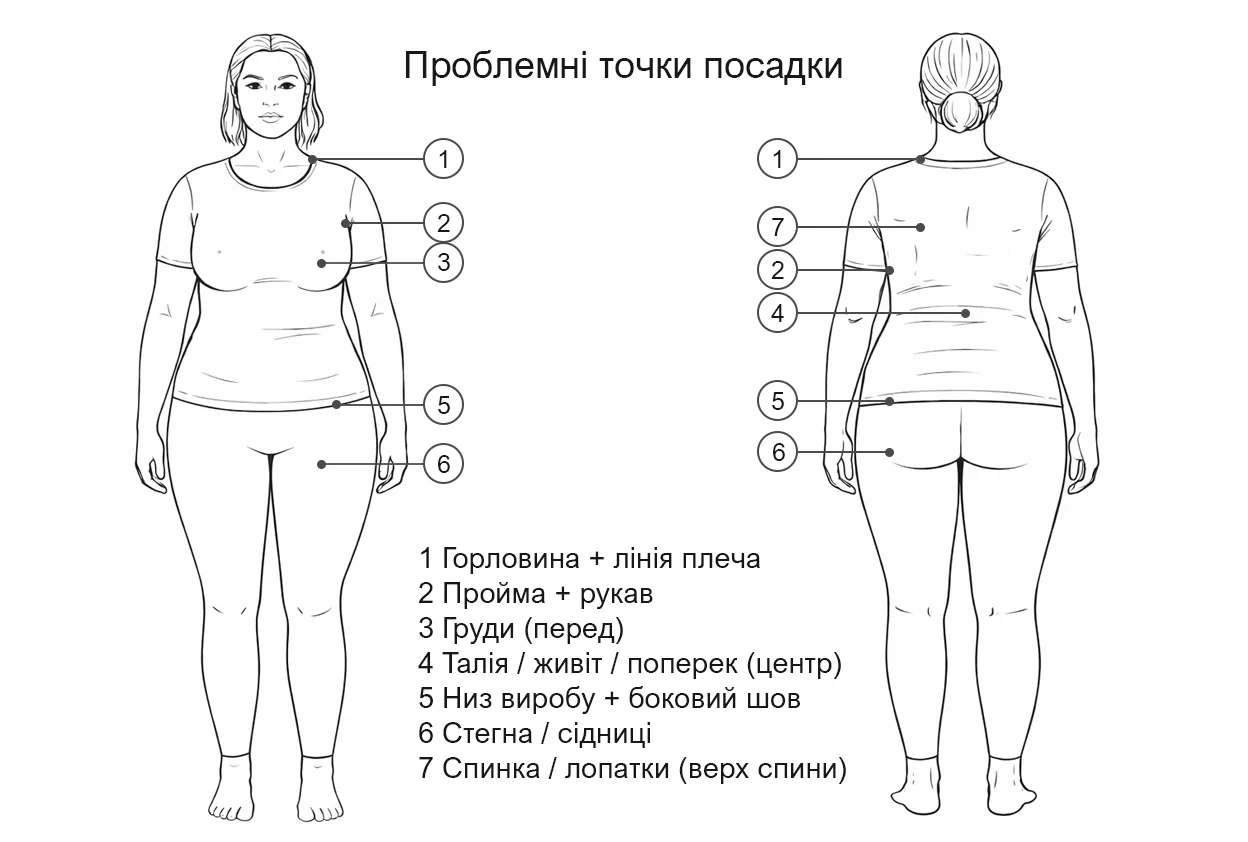
- 1 — Neckline + shoulder line: Slides/skews the shoulder, the neckline pulls forward or backward, "wanders" at the neck.
- 2 — Armhole + sleeve: Pulls at the underarm, restricts movement, the sleeve "jumps," creases near the armhole.
- 3 — Bust (front): More often not tension but "emptiness"/a crease: sags at the bust, odd folds from the bust to the armhole/center.
- 4 — Waist / waistband / lower belly: The waistband squeezes or twists, "rides up" while moving, gathers into folds at the center/lower back.
- 5 — Hem + side seam: A critical point for the pear shape: the hem "sits in a wave," pulls along the side seam, skews at the bottom; the front or back hem becomes shorter/jumps.
- 6 — Hips / seat: Tension and creases at the hips/seat, the pant legs twist, the piece pulls down or rides up at the back while moving.
- 7 — Back / shoulder blades (upper back): Horizontal creases between the shoulder blades, tension in the upper back, a feeling that the sleeves are "pulled" backward.
The diagram above shows where fit most often "breaks" in plus size clothing for the pear (A) body type. This isn't about "flaws," but about zones where a garment's cut and proportions show themselves fastest in movement. For a pear shape, problems most often appear at the bottom: along the garment's hemline and side seam (5) and in the hip/seat zone (6) — where fabric can pull, skew, or jump. The upper points (1–3, 7) are responsible for the silhouette's gathered look and balance, and point (4) is responsible for comfort and stability at the waist/waistband. Further in the article, we'll build on these zones when discussing lengths, lines, and styles that give the pear shape lightness and confidence in fit.
Proportions in clothing for the "Pear" (A) body type: how to "lift" the waist and gather the silhouette
Proportions are how we divide the figure into parts with clothing: where the top ends, where the bottom begins, at what height the waist "sits," and at what point the eye reads the transition between top and bottom.
For the pear (A) body type, proportions aren't about "slimming the hips." They're about something else:
- visually "lifting" the waistline so the legs seem longer
- making the silhouette put-together so the bottom doesn't look "heavier" just because of a poor length
- not placing a rigid boundary at the hips' widest point (this is the main "look-breaker")
- giving the top support so the top and bottom work as one silhouette, not as two separate things
And an important thought: for a pear shape, proportions work even when "everything is simple" — a t-shirt and pants. Because what matters isn't the complexity of the piece, but where it ends and how the emphasis is placed.
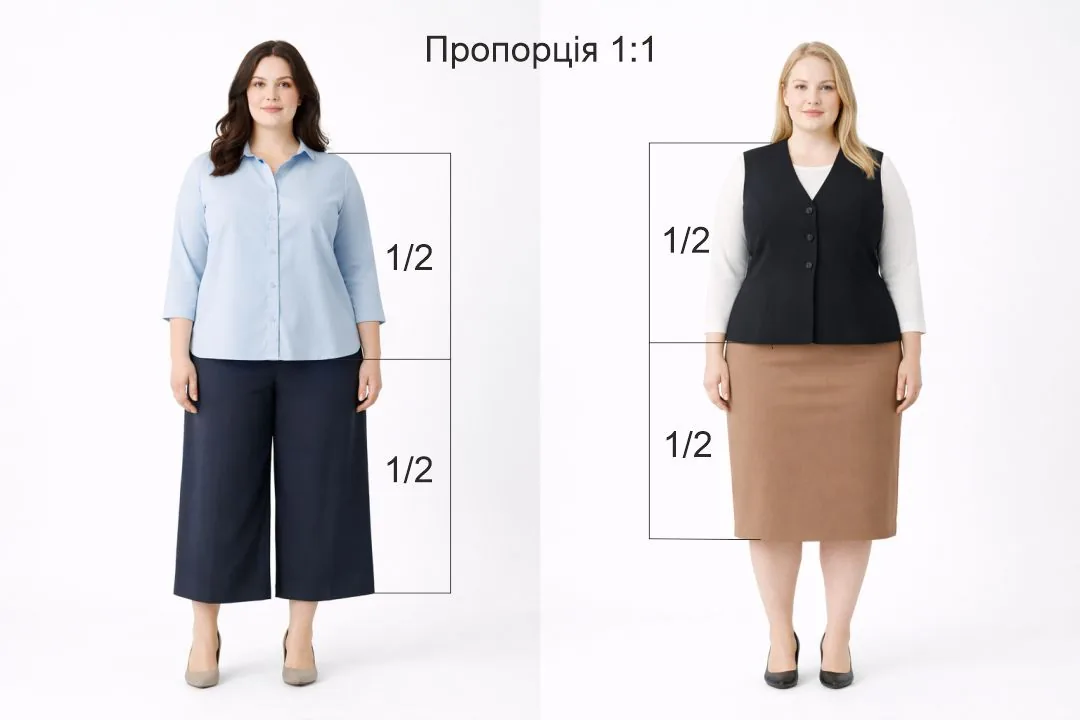
1:1 Proportion
Top 1/2 + bottom 1/2 (the outfit looks even and put-together)
The idea: we divide the figure almost in half — the top is roughly equal to the bottom.For a pear shape, this gives something very important: a calm silhouette without a sharp emphasis on the hips.
What it looks like in real life:
- a top to the waistline / to the start of the hips (not at the widest point!)
- the bottom (skirt/pants) logically "picks up" the length — the outfit reads as even
When it works best:
- for medium and short height, when you want to neatly "elongate" the silhouette without going to extremes
- when you want a "polished and put-together" look even in basics
- when it matters not to overload the bottom
The key condition for a pear shape:
- the top should either end above the widest point, or pass below it.The worst option is a hem landing exactly "at the hips."
What enhances the 1:1 proportion:
- an outfit in one color or close tones (especially for shorter height)
- verticals at the top (a placket, a V-line, an open layer)
1:2 Proportion
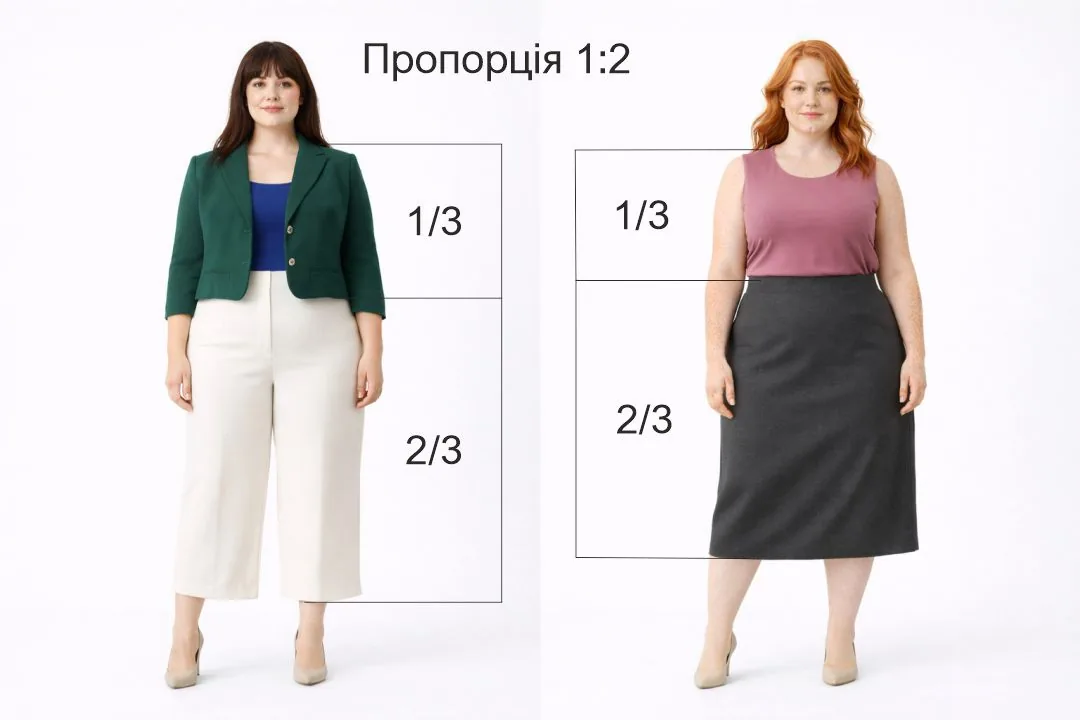
Top 1/3 + bottom 2/3 (longer legs, a higher waist)
The idea: the top is shorter, the bottom is longer — and the eye reads: "the legs are the main length."For a pear shape this is gold, because this proportion often visually lifts the waist and adds lightness.
What it looks like in real life:
- a top to the waist or slightly above the start of the hips
- the bottom "pulls" the silhouette downward: pants/a skirt with the right fit
When it works best:
- for medium and short height, when you want +2–5 cm "visually"
- when the waist seems lowered — the proportion lifts it
- when the bottom is active but you want the look to feel lighter
What matters specifically for a pear shape:
- the top must be put-together and structured, otherwise the proportion will "fall through" (the top becomes accidental and the bottom takes all the emphasis)
- the bottom — as clean along the line as possible (no excess volume at the hips)
Tricks that work:
- tucking in (partial/full), cropped tops, shorter blazers
- emphasis at the top (the neckline, an accessory, texture) — so the balance feels natural
1:3 Proportion
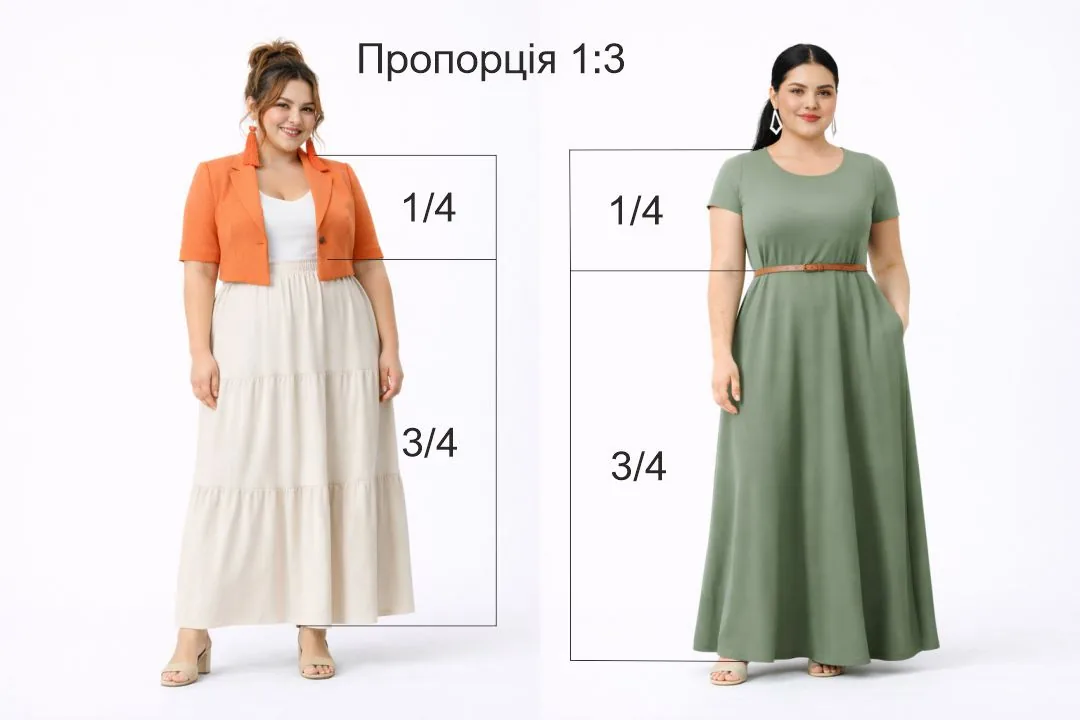
Top 1/4 + bottom 3/4 (maximum "long legs")
The idea: a very short top makes the bottom as long as possible — and the legs seem longer.This is the strongest proportion for "elongating" the silhouette.
What it looks like in real life:
- a cropped blazer/jacket/cardigan to the waist
- pants/a skirt with a fit that holds the waist and doesn't cut into the hips
When it works best:
- when you want a "wow effect" of long legs
- when the bottom is simple and fits well
- when the top has structure (shoulder/collar/lines)
Be careful (important for a pear shape):
- if the top ends at the hips instead of the waist, the effect breaks down
- if the bottom is "heavy" (creases, pulls, skews), 1/4 will only emphasize the problem. So fit comes first (zones 5–6), then proportion.
What makes the proportion even stronger:
- monochrome
- shoes matching the bottom's tone
- a vertical layer on top (if the top isn't super short)
Proportions aren't strict formulas, but a tool for managing the silhouette. For a pear shape, they work when we don't place a rigid boundary at the hips' widest point and don't make the top and bottom "compete" with each other.The 1:1 proportion gives stability and a put-together look, 1/3–2/3 lifts the waist and adds height, and 1/4–3/4 elongates the legs as much as possible and makes the look lighter — provided the bottom fits cleanly. It's important not to copy the proportion literally, but to read it with your eyes: where the top ends, where the bottom begins, and which part of the figure we're making the anchor. That's exactly what gives a sense of harmony — regardless of size.
Ending points in clothing for the "Pear" (A) body type
An ending point is where a piece ends: the hem of a top, a blazer, a cardigan, a dress.For a pear shape, this is critically important, because this is exactly where the silhouette either gathers together or breaks apart — regardless of style or size.
The main rule
Clothing shouldn't end at the widest point of the hips.This creates a rigid horizontal that immediately emphasizes volume and "cuts off" the legs.
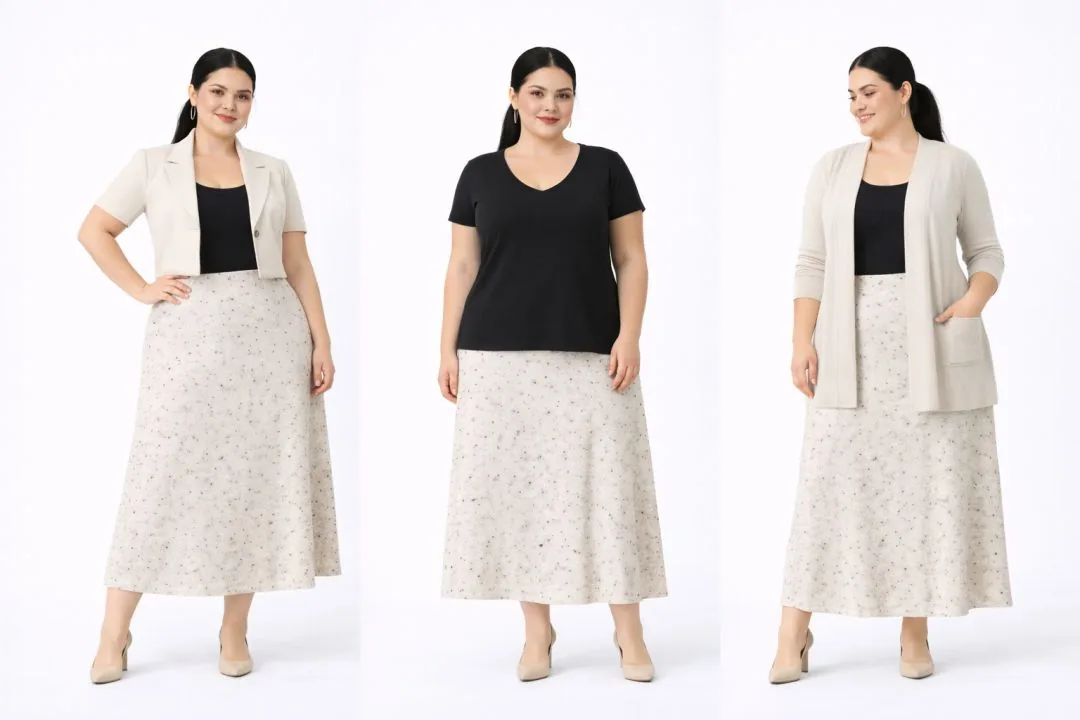
3 safe ending points for a pear shape
1. Above the widest point (at the waist / start of the hips)
- works for short blazers, vests, tucked-in tops
- lifts the waist
- elongates the legs
- combines well with the 1/3–2/3 and 1/4–3/4 proportions
Important: the top must be put-together and structured, otherwise the silhouette will "fall apart."
2. Below the widest point (mid-thigh and lower)
- works for elongated tops, tunics, cardigans, blazers
- "passes by" the problem zone
- calms the bottom and makes the silhouette more even
Important: the hem shouldn't be rigid — it's better if there are slits, asymmetry, or a soft line.
3. Maxi (for dresses and bottoms)
- the strongest ending point
- elongates the silhouette
- removes focus from the hips
- works perfectly with the 1/4–3/4 proportion
Important: the top in maxi looks should be shorter or clearly separated at the waist.
Lengths in clothing for the "Pear" (A) body type
For the pear body type, lengths in clothing play a key role. They determine whether the silhouette looks gathered and light, or whether the bottom starts "pulling" the look downward — even if the style and size are chosen correctly.
One basic thing matters here:clothing shouldn't stop at the active hip zone.It should either end above this zone, or pass beyond it, without creating a rigid emphasis.
The diagram above shows the approximate zones where lengths work most reliably for a pear shape. These aren't rules, but reference points that are convenient to build on when choosing pieces.
Top lengths: where they work best
For a pear shape, there are two zones where a top almost always looks good.
Short lengths — above the hipsThese are tops that end at the waist or just after it:short blazers, vests, tucked-in shirts, tops, cropped cardigans.
Such lengths:
- visually lift the waist,
- elongate the legs,
- work well with the 1/3–2/3 and 1/4–3/4 proportions.
An important nuance: a short top for a pear shape needs to be put-together and structured. Soft, "blurred" shapes at this length can look cut off.
Elongated lengths — below the hips' widest pointThese are blazers, cardigans, tunics, elongated shirts.
Such tops:
- don't emphasize the hips,
- calmly "pass by" the active zone,
- make the silhouette more even.
They work best when the hem isn't rigid: there are slits, asymmetry, or a soft bottom line.
The trickiest zone is when a top ends exactly at the hips' widest point.This is exactly where the feeling of a heavy bottom most often appears, even in good pieces.
Skirt and dress lengths
For a pear shape, lengths that don't stop the eye at the legs' active zones are considered stable.
Midi below the kneeOne of the most versatile and calmest lengths.Works well both in straight silhouettes and in a light A-line.
MaxiA strong length for a pear shape. It:
- elongates the silhouette,
- removes focus from the hips,
- pairs well with a shorter or clearly gathered top.
Lengths that end at the widest part of the calf need careful pairing with the top — it's important here that the look doesn't "cut off" in the middle.
Pants lengths
Pants for a pear shape work when they don't create an extra emphasis at the bottom.
- Full length or 7/8 are the most stable options.
- Cropped models look good when the ankle shows and there's lightness in the lower part of the look.
- Pants that are too long without structure or shoe support can "pull" the silhouette downward.
How to combine lengths with each other
For a pear shape, what matters isn't an individual length, but the balance between top and bottom.
The best-working combinations are:
- a shorter or gathered top + a longer bottom,
- an elongated top + a calm bottom that's clean along the line,
- a maxi bottom + a clearly defined top.
When lengths are coordinated with each other, the look appears whole and modern — without needing to "hide" or fix anything.
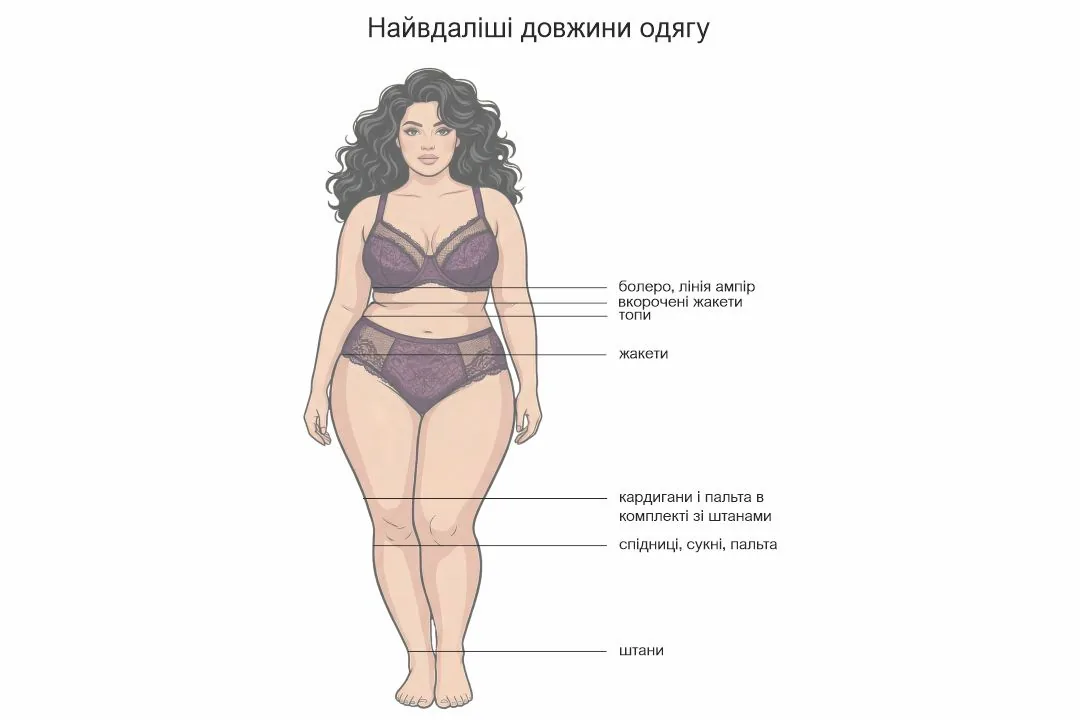
The diagram shows approximate zones where clothing lengths work most reliably for the pear body type.It's not about "it must be this way," but about logic: where the top is better ended, and where it's better to pass by, so as not to create a rigid emphasis on the hips.
Short tops and cropped blazers raise the silhouette's starting point and elongate the legs. Elongated tops, cardigans, and coats that pass below the active hip zone even out the proportions. Skirt, dress, and pants lengths work when they don't "stop" the eye at the widest points, but lead it further down.
The diagram helps you quickly get oriented with lengths, but the final decision should always be made in motion and in combination with a specific look.
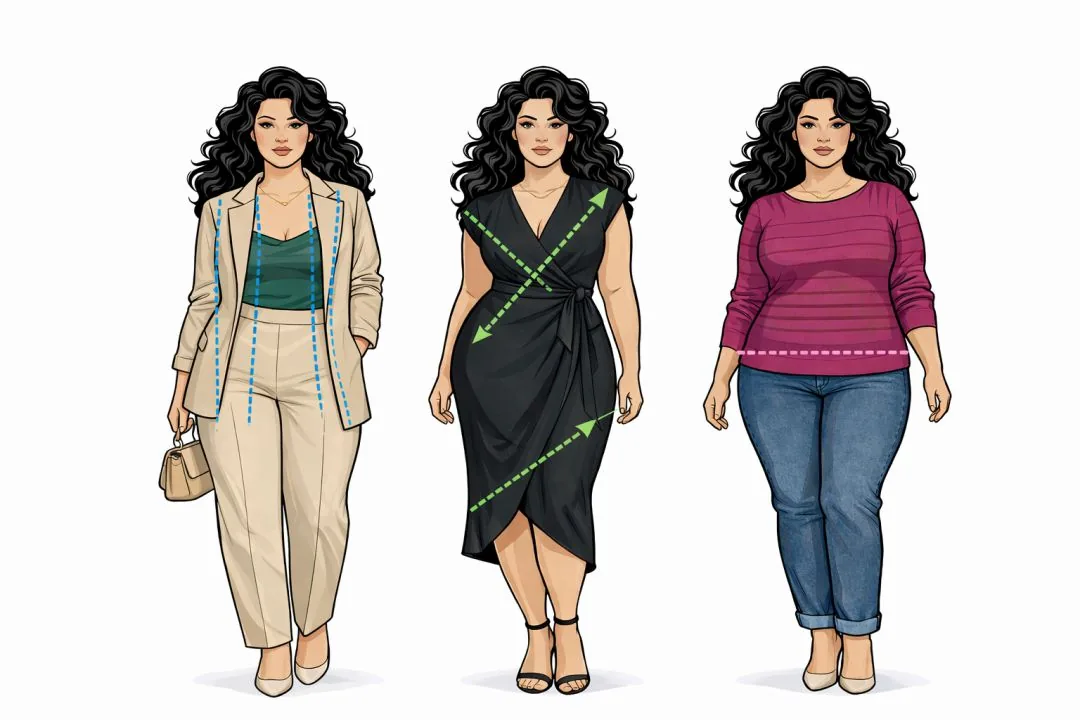
Lines in a look: verticals, horizontals, diagonals
When working with the pear body type, lines in clothing matter just as much as style or length. They control the eye:where it moves, where it stops, and what it focuses on.
Lines are formed not by diagrams but by real clothing details — seams, garment edges, necklines, closures, pleats, color transitions. Understanding how they work helps make a look gathered and light without complicated tricks.
Vertical lines: elongate and gather the silhouette
Verticals are the pear shape's most reliable allies. They lead the eye from top to bottom without lingering at the hips, and visually elongate the figure.
Vertical lines can appear through:
- a center closure or placket,
- V-shaped necklines,
- elongated blazers and cardigans,
- vertical seams, seam shaping,
- restrained pleats that "fall" downward.
For a pear shape, verticals work especially well in the upper part of the look — they balance the dominant bottom and make the silhouette calmer.
Horizontal lines: a zone of heightened attention
Horizontals always draw the eye and "fix" it at a specific spot. They aren't bad on their own, but for a pear shape, what matters is exactly where they appear.
Horizontal lines are formed by:
- the edge of a top or blazer,
- belts,
- contrasting color transitions,
- cuffs, the hem of a skirt or dress.
If a horizontal crosses the widest point of the hips, it emphasizes volume in that zone. That's exactly why tops that end right at the hips often look "heavy," even if the style itself is correct.
By contrast, horizontals placed:
- above the waist,
- or well below the active zone,
are perceived much more calmly and don't break the silhouette.
Diagonal lines: movement and lightness
Diagonals are among the most effective lines for the pear body type. They don't stop the eye but lead it along a trajectory, creating a sense of movement and lightness.
Diagonals appear through:
- a wrap,
- asymmetric details,
- angled cut lines,
- soft draping,
- shifted accents.
For a pear shape, diagonals are especially useful in the top and waist area — they blur the rigid boundary between top and bottom and help avoid a "divided" silhouette effect.
How lines work together
The best looks for a pear shape are rarely built on a single line. Usually it's a combination of:
- verticals that elongate,
- soft diagonals that add movement,
- a minimum of rigid horizontals at the hip zone.
When lines support each other, clothing stops "fighting" the figure and starts working for it.
An important nuance
Lines don't exist separately from lengths and proportions. They start working only when they're built into the overall logic of the look — exactly where they run, where they appear, and where they end. That's exactly why the same piece can look different depending on its combination with other elements.
Fabrics and textures in clothing for the "Pear" (A) body type
For the pear body type, fabric works just as actively as cut or length. The same model in a different material can look completely different: it can gather the silhouette, or, conversely, make the bottom heavier.
What matters here isn't the fabric's name, but its behavior in motion — how it holds shape, where it adds volume, and where it "falls."
Fabrics for the top: where you can add weight
The upper part of the look for a pear shape is a zone where fabric can work for balance.
Materials that work well are those that:
- hold their shape or have density,
- create clear lines,
- add visual presence to the top.
These can be:
- suiting fabrics,
- dense knits,
- jacquard,
- textured fabrics or those with light relief.
Such materials help balance the dominant bottom and make the look put-together without extra decoration.
Fabrics for the bottom: lightness instead of stiffness
The bottom for a pear shape works better when the fabric:
- doesn't hold a rigid shape,
- doesn't "stand apart" from the body,
- softly follows movement.
Fabrics that are too dense, stiff, or "standing" at the hip zone often emphasize volume and make the silhouette heavier.
Soft, fluid fabrics, on the other hand, allow you to:
- remove excess emphasis from the hips,
- make the lines smoother,
- preserve the silhouette's femininity.
Texture and relief: where to be careful
Textured fabrics, surface relief, and large patterns always draw attention. For a pear shape, what matters is which zone they appear in.
- In the upper part of the look, texture can work for balance and visual interest.
- In the hip and seat zone, active texture often emphasizes volume, even with the right style.
That's why it's better to choose visually calm materials for the bottom, without sharp texture contrasts.
Contrasting fabrics in an outfit
Combining different fabrics within one look is a powerful tool for a pear shape.
When the top is made of a denser or more textured material and the bottom is soft and fluid, the silhouette looks balanced and whole.If both parts are equally stiff or equally bulky, the look can lose lightness.
An important nuance
Fabrics don't work separately from cut, lengths, and lines. It's their combination that determines whether clothing looks put-together and harmonious. So when choosing pieces for the pear body type, it's worth evaluating not the material on its own, but how it behaves in a specific garment.
Colors and prints in clothing for the "Pear" (A) body type
Color and print for the pear body type aren't a question of "allowed or not," but a question of exactly where they appear and which zone they emphasize. Even the most successful style can look heavy if the color or pattern works against the silhouette's logic.
For a pear shape, it's important to remember:the eye always travels to wherever it's lighter, brighter, more contrasting, or more active.
Color: how to distribute visual weight
The most stable scheme for a pear shape is more light and complexity at the top, more calm at the bottom.
- Light, bright, complex, or deep colors at the top help balance the silhouette.
- Darker, muted, or neutral shades at the bottom remove excess emphasis from the hips.
This doesn't mean the bottom has to be only black. What matters is that the color:
- isn't sharply contrasting with the top,
- doesn't "jump out" first,
- doesn't divide the silhouette horizontally.
Monochrome looks or outfits in close shades work especially well for a pear shape, because they create a continuous vertical.
Contrast in an outfit
Contrast is a powerful tool, but for a pear shape it requires precision.
- Contrast in the upper part of the look (color, texture, details) usually works for balance.
- Contrast at hip level or between top and bottom right in that zone often "cuts" the silhouette and emphasizes volume.
If a contrasting bottom is used, it's better that:
- it's elongated,
- or it's supported by a calm, gathered top.
Prints: where they work, and where they don't
A print always adds visual weight, so for a pear shape what matters isn't so much which print, but where it's placed.
Prints in the upper part of the look:
- help balance proportions,
- draw attention away from the bottom,
- add character and a modern feel.
Prints in the hip and seat zone:
- immediately emphasize volume,
- draw attention to the active zone,
- often work against the silhouette, even in correct styles.
That's exactly why it's better to choose for the bottom:
- calm colors,
- a small or barely noticeable pattern,
- or solid-color solutions.
Print scale and rhythm
For a pear shape, print scale matters:
- a large, active pattern in the lower part of the look makes the silhouette heavier,
- a smaller, rhythmic, or "blurred" print is perceived more softly.
In the upper part of the look, you can allow yourself a bolder scale — that's exactly where a print works for balance.
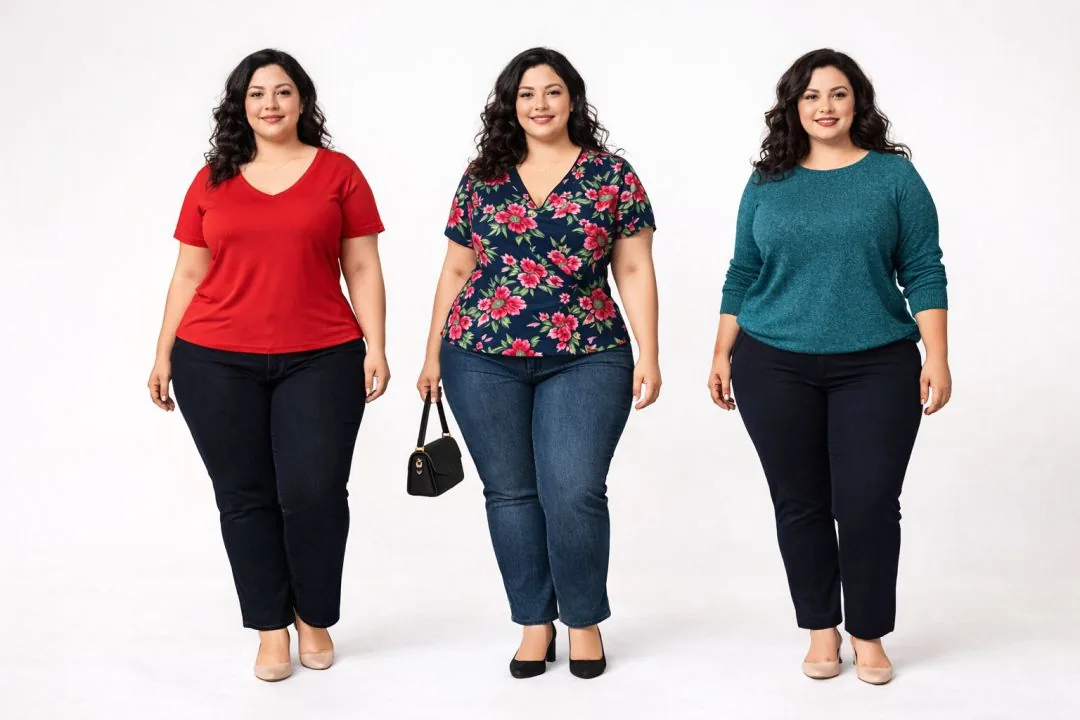
The pear body type doesn't need fixing — it needs understanding. When fit, proportions, lengths, lines, fabrics, and color work together, clothing stops being a compromise and starts being a choice.
In this article, we didn't talk about "masking" or "correction." We talked about logic: where emphasis appears, where the eye is led, and why some solutions look put-together while others don't. It's exactly this logic that lets you build a wardrobe consciously — without rigid rules and without the constant feeling that "something's wrong."
And one more thing
No body type can be reduced to diagrams. They're only meant as a guide. The final decision is always born in movement, in the mirror, and in your own sense of comfort. When clothing doesn't get in the body's way but supports it — it always shows.
What colors and prints suit the "Pear" body type?
The most reliable approach is more light and complexity in the upper part of the outfit and more calm below: lighter/brighter colors and prints on top, darker, quieter tones and a small or no print on the bottom.
What’s the best length to end a top at for a "Pear" shape?
There are three safe endpoints: above the widest point of the hips (at the waist), below the widest point (mid-thigh or lower), or maxi length. The worst option is a hem that ends exactly at the widest point of the hips — it creates a hard horizontal line and emphasizes volume.
What is the main goal of clothing for the "Pear" body type?
Clothes shouldn’t "fight" the hips or hide them — the goal is a put-together silhouette: free, clean fit at the bottom, added structure ("frame") on top, the right hemlines, and a top and bottom that read as one cohesive silhouette.
What are the strengths of the "Pear" body type?
The legs are one of the strongest features, often proportionate and well-shaped; there’s a clear difference between top and bottom, which makes it easy to play with lengths; soft, feminine silhouette lines; a predictable, stable figure — once the right proportions are found, outfits look put-together without constant compromise.
How do you know if you have a "Pear" body type?
Look at yourself from the front in a photo wearing neutral clothing: the hips are wider than the shoulders or look heavier in the silhouette, and clothes tend to fit poorly lower down — pulling at the hips, skirts riding up, fabric bunching.
What is the "Pear" (A) body type?
It’s a proportion type where the main volume is concentrated in the lower body — hips, buttocks, sometimes the upper legs. The upper body looks calmer by comparison: narrower shoulders, a less "dominant" bust area, a more visible waist.